

Trading coaching needs room for both instructor-led lessons and independent practice. A live Zoom lesson can explain a concept and help you question it; revision is where you try applying it without the instructor leading each step. Before enrolling, separate teaching hours, guided exercises and personal study, then compare the actual timetable and fee coverage with your work schedule.
Table of Contents
- What counts as class time, and what counts as practice?
- Does live Zoom mean learning during live market hours?
- How can you build a practice routine around work?
- What should you compare beyond the coaching fee?
- When is a classroom a better alternative to online lessons?
- A worked example: choosing a plan that survives a busy week
- How can Tips2Trade fit your timetable decision?
- Frequently Asked Questions
A trading coaching timetable can fit your evenings and still leave too little space for learning. If you attend every lesson but never revisit a chart yourself, you have scheduled attendance rather than a complete study routine.
Start with the distinction between time with an instructor and time spent working independently. Then consider whether the lesson happens during an open market, what feedback follows your practice, and whether classroom attendance would solve a real problem with online learning. The useful comparison is the arrangement you can sustain alongside work, including busy weeks, rather than the course with the shortest advertised duration.
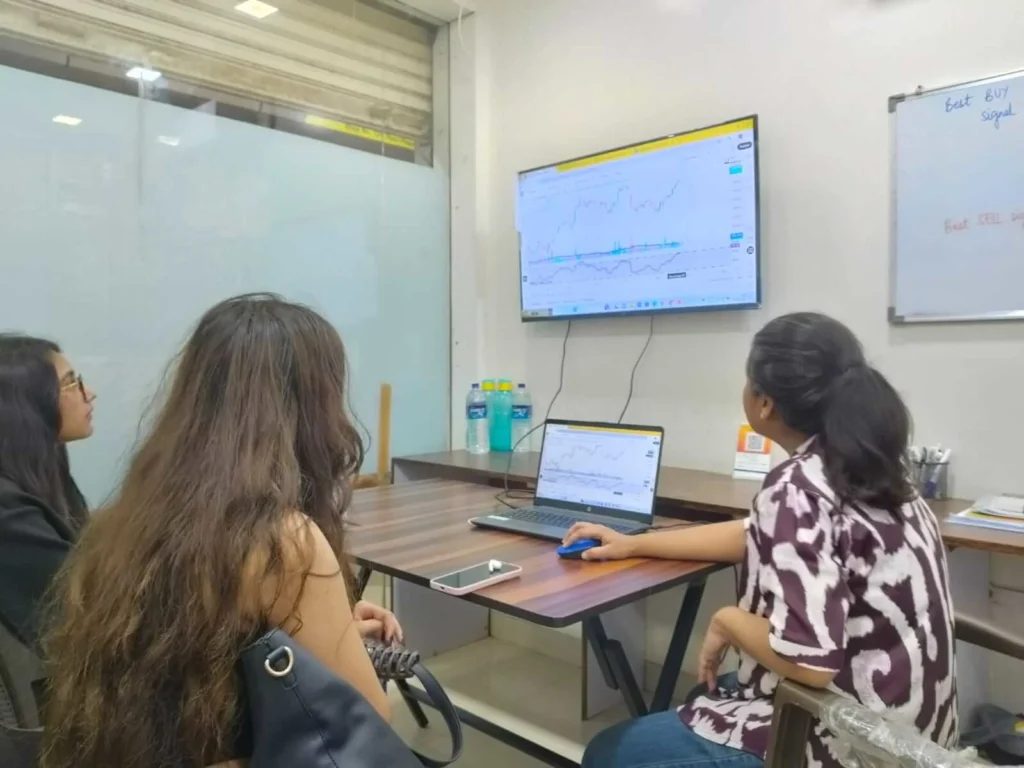
Three women viewing trading charts in a classroom Client photo (website)
What counts as class time, and what counts as practice?
A course’s calendar duration tells you when it starts and finishes. It does not, by itself, tell you how much instructor contact, guided application or independent work sits inside that period.
Our online program page lists a two-week duration and includes real-market case studies and practical assignments. That gives you a published course period and practical work to plan for, but it does not establish total teaching hours or a separate allowance for independent revision.
Ask for the session count, session length and expected weekly practice before translating that duration into a commitment. Also establish whether assignments happen inside lessons or afterward, who reviews them and when feedback takes place. These are different demands on your calendar.
For planning purposes, separate the activities below. This is a way to understand a course, not a statement that every provider includes each activity.
| Activity | Who leads it | What you should produce | Scheduling implication |
|---|---|---|---|
| Concept lesson | Instructor | Notes and a clear understanding of the method | Attend at the agreed lesson time |
| Guided application | Instructor with learner participation | An attempt you can explain and question | Check whether it is included in lesson time |
| Independent revision | You | A fresh attempt without following a demonstration | Reserve a separate study block |
| Feedback and correction | You and the instructor, if included | A corrected explanation or practice record | Check the review method and access terms |
Watching an example is different from making a decision
During a demonstration, the instructor may choose the chart, point out the relevant area and explain the next step. During independent work, you have to decide which information matters before anyone gives you the answer.
Use that distinction to judge your progress. Being able to follow an explanation is useful, but try explaining your own choice on a different chart before treating the lesson as understood.
There is no automatic class-to-practice ratio
Do not assume that a lesson requires an equal amount of revision or that the advertised course period includes all personal study. Your starting knowledge, the topic and the assigned work affect what you need.
Build an initial routine, then adjust it using your actual attempts. If you cannot complete an exercise without replaying the demonstration, reserve more application time before adding new material.
Does live Zoom mean learning during live market hours?
No. A live Zoom class means the instructor and learner meet at the same time. It does not automatically mean an exchange is open or that the lesson includes current market observation.
A session can use an earlier chart, examine a completed market move or discuss a practice exercise. Those activities have a different purpose from observing prices as they change.
Ask what the proposed lesson actually involves: explanation, current-chart observation, learner practice or review of completed work. A timetable can look suitable until you discover that the activity you want happens while you are at work.
Match the activity to your availability
If your job prevents daytime attendance, an after-work lesson may still suit conceptual learning and chart review. But it should not be treated as equivalent to practicing decisions during an open market.
Completed charts let you pause and examine your reasoning, although the visible outcome can make a decision look easier than it was. When possible, record your interpretation before examining what happened next.
For real-time observation, distinguish watching from acting. You can study how a setup develops without placing a funded trade; ask whether the proposed activity requires an account or can remain an educational exercise.
How can you build a practice routine around work?
Start with the week you normally have, not the week you hope to have. Include work, household responsibilities and the time needed to settle into a lesson without interruptions.
Then identify a separate window for applying the material. Online attendance removes the journey to a classroom, but it does not make revision disappear.
Plan each practice block around a small, observable task. ‘Study trading’ is difficult to finish; ‘mark a chart, explain the decision and identify what would invalidate it’ gives you something to review.
Use a repeatable lesson-to-revision sequence
- Before class, revisit the previous topic and note the point you could not explain.
- During class, record the reasoning behind the example rather than only its conclusion.
- After class, attempt a different example without following the instructor’s steps on screen.
- Bring the attempt and your specific question to the next available review opportunity.
Keep the record simple: the chart or exercise, your reasoning, the result and the correction. A long journal is not necessary if it makes you avoid practicing.
Make revision useful even when the outcome is disappointing
For an educational chart exercise, write down the intended entry condition, the reason for it and the condition that would make you reject it. You can also record why you would choose not to participate.
Review the decision against the method you were trying to apply. A favorable price move does not prove that your reasoning was sound, just as an unfavorable move does not explain which part of your process needs correction.
If a busy week leaves room only for attendance, avoid treating unfinished exercises as completed learning. Reduce the amount of new material you attempt until you can explain and apply the earlier lesson.

Man seated at desk studying charts on two monitors Client photo (website)
What should you compare beyond the coaching fee?
Compare the work included in the fee, not just the amount quoted. Our online program page lists an individual fee of ₹15,000, describes the course as 1-to-1 personal training and states that lifetime support covers solving doubts or queries.
Individual teaching gives you a direct setting for discussing your reasoning. For your timetable decision, distinguish that instructor contact from independent assignments and later doubt support. The published description does not establish how much assignment review or additional revision teaching is included.
Our broader beginner-course blog describes lifetime access to course materials and recordings. Confirm whether those benefits apply to the selected online course rather than treating the broader statement as a confirmed inclusion in your quote.
A lower quote might fit if you mainly need explanations and can revise independently. A different arrangement may be more suitable if you need someone to examine your attempts, provided that review is genuinely included. Use these questions to compare the actual work covered:
- How much of each session is explanation, learner application and feedback?
- Are assignments reviewed, and does review happen during paid lesson time or separately?
- Are recordings and materials included in the selected course, and how long can you access them?
- Does the quoted amount include any required tools or other charges?
- Are scheduled revision sessions included or charged separately?
- What channels, scope and response expectations apply to lifetime doubt support?
- What happens if work prevents you from attending an agreed session?
Treat recordings and doubt support as separate benefits
A recording lets you revisit an explanation. Feedback helps you understand an error in your own work. One does not automatically provide the other.
If ongoing or lifetime support is part of a quote, establish what it covers: the contact channel, eligible questions, any response expectations and whether additional teaching is separate. Also distinguish an occasional clarification from a scheduled revision session.
Keep a written summary of the selected course’s inclusions before payment. That gives you a clear reference when organizing your study routine.
When is a classroom a better alternative to online lessons?
A classroom is worth considering if your home or workplace does not provide a reliable place to participate, or if attending in person helps you protect lesson time. Live online instruction is worth considering if travel would use the time you need for revision.
Neither format removes independent work. Choose the arrangement that addresses your actual obstacle rather than assuming the best stock market class must use a particular medium.
| Format | Potential fit | Trade-off | Establish before choosing |
|---|---|---|---|
| Live online instruction | You have a quiet study space and want to avoid travel | You still need uninterrupted attendance at the agreed time | Timetable, participation method and feedback access |
| Classroom instruction | You prefer face-to-face discussion or need a separate learning environment | Travel takes time that could otherwise support revision | Actual teaching schedule and total door-to-door commitment |
| Recorded learning | You need control over when you watch explanations | Playback does not itself provide feedback on your work | How questions and practice attempts are reviewed |
Flexible learning still needs a workable agreement
Flexibility might mean a choice between schedules, an individually agreed lesson time or access to material after class. It should not be interpreted as permission to change attendance at any time.
Likewise, weekend attendance may solve a clash with work but leave little time for revision between lessons. Check the whole learning sequence, including when you can prepare questions, rather than comparing the lesson slot alone.
If you are searching for the best trading classes near you, evaluate the journey at the time you would actually attend. A location that suits your workday may not suit a weekend routine.
| Format | Best fit | Trade-off | Confirm first |
|---|---|---|---|
| Live online | Quiet study space; avoid travel | Needs uninterrupted attendance | Timetable and feedback access |
| Classroom | Separate space; face-to-face discussion | Travel reduces revision time | Schedule and door-to-door commitment |
| Recorded learning | Control when you watch explanations | Playback alone does not provide feedback | How questions and attempts are reviewed |
A worked example: choosing a plan that survives a busy week
Say you work during the day, sometimes finish late and have a quiet study space at home. You can protect part of the weekend for revision, but your weekday finishing time varies.
Begin by separating reliable availability from occasional availability. Your protected weekend study period belongs in the plan; an evening that regularly disappears into work should not be the foundation of it.
Next, compare the actual options. A live online lesson avoids travel, but a fixed start that overlaps with late finishes remains a problem. Recorded material lets you watch later, but you would need a separate way to get useful feedback on your attempts.
A classroom session could provide a clearer boundary between work and study. However, if the journey consumes your protected revision period, it solves attendance while creating an application problem.
The choice follows from the dependency: you need a reliable lesson slot and a remaining practice window. An online arrangement fits only if its agreed timing works; a classroom arrangement fits only if attendance and travel leave room to revise.
Once a timetable is proposed, put it into your calendar alongside independent work. After starting, use your unfinished exercises and recurring questions to judge whether the routine needs adjustment, rather than counting attendance alone.
How can Tips2Trade fit your timetable decision?
We are a share market training institute with offices in Mumbai at Dadar West and Andheri West, and in Vashi. Our published pages describe classroom options at Dadar West, Andheri and Vashi, as well as live online learning via Zoom or Google Meet. Online instruction can remove travel from your study routine; a classroom can give you a separate place to protect lesson time.
Our location pages also describe flexible learning options, including weekday and weekend batches. These published descriptions do not confirm current availability or establish that you can attend outside live market hours. If your job clashes with daytime learning, the actual proposed timing is what determines whether an option fits.
Bring your working hours and the study windows you can reliably protect. Use our contact details and office information to prepare the conversation, then visit our website and call the number below to confirm current Zoom timings, fee coverage and suitable classroom options. The aim is a proposed learning arrangement you can assess, with separate time left for independent revision.