
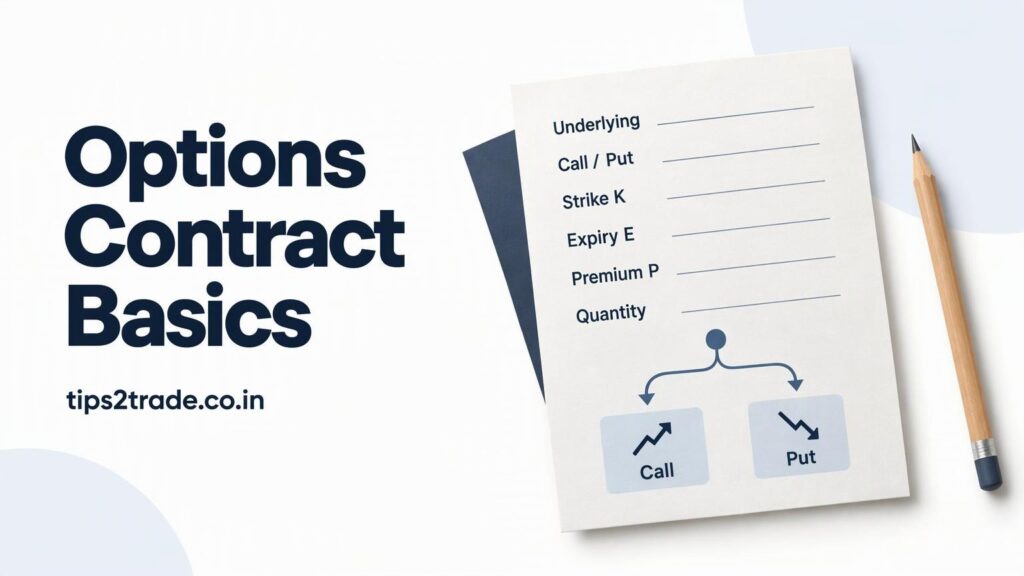
An options contract gives its buyer a right linked to an underlying asset at a specified strike price, subject to an expiry and settlement rules. A call concerns the right to buy; a put concerns the right to sell. To follow an introductory lesson in Andheri, start by identifying the underlying, option type, strike, premium, expiry, and quantity, then explain how the premium changes the buyer’s expiry result.
Table of Contents
- What does an options contract actually tell you?
- How do you read a labeled contract example?
- How do you interpret an expiry payoff diagram?
- Why is an expiry calculation different from a live option price?
- Are you ready to follow an introductory options lesson?
- How does this primer connect to learning in Andheri?
- Frequently Asked Questions
If you are considering options contract classes in Andheri, the useful starting point is whether you can explain a contract without relying on a trading tip. Recognizing the words call and put is a start, but you also need to distinguish the asset’s price from the option’s price.
This primer connects options terminology to a labeled example and a simple expiry diagram. It focuses on a buyer’s standalone call or put, before trading costs, rather than strategies or market predictions. The final readiness check helps you decide whether to begin an introductory derivatives lesson or first review stock-market basics.

Women attending a trading lesson with charts on screens Client photo (website)
What does an options contract actually tell you?
A contract identifies the right being traded and the terms attached to it. It is different from buying the underlying asset outright: you are paying for an option whose value depends on that asset and whose contractual life is limited.
The underlying may be a stock or an index. Its market price is separate from the option premium, so an option quote should never be read as the price of the underlying itself.
For an introductory lesson, learn the fields together. A strike without an option type does not tell you whether you are looking at a call or put; a type and strike without an expiry do not identify the complete contract.
Calls and puts describe different rights
A call gives the buyer a right to buy the underlying at the strike under the contract’s terms. A put gives the buyer a right to sell at the strike. Cash-settled contracts express these rights through a settlement calculation rather than an exchange of the underlying.
For the simple expiry calculations here, a call has positive exercise value when the underlying finishes above the strike. A put has positive exercise value when it finishes below the strike. That describes value at expiry, not whether the buyer has recovered the premium.
Buying a put is also different from writing, or selling to open, a call. Those positions have different obligations and risk profiles, even though both may appear in discussions about falling prices.
Strike, premium, and expiry have separate jobs
The strike price is the contract’s reference price for exercise. It is not what you pay to buy the option and is not a prediction that the market will reach that level.
The premium is the price paid by the buyer for the option. The quoted amount must be interpreted with the applicable contract quantity or multiplier to understand the total premium commitment.
Expiry identifies the end of the contract’s life. The exact date, trading cutoff, exercise process, and settlement requirements belong to the specific product’s rules; do not substitute a remembered weekday for the contract details.
How do you read a labeled contract example?
Say you are preparing for your first lesson and see a call quote. Instead of starting with whether it looks cheap, label each field and translate the quote into a sentence.
Use letters for this teaching example: K is the strike, P is the premium paid per underlying unit, and E is the stated expiry. These are labels, not current market quotations. The example deliberately leaves the quantity as a field to read rather than assuming a lot size.
Your sentence becomes: “I am looking at a call on the stated underlying, with strike K and expiry E, quoted at premium P per unit, subject to the stated contract quantity and settlement rules.”
| Contract field | Example label | What you should identify |
|---|---|---|
| Underlying | The stated stock or index | What the option derives its value from |
| Option type | Call | The buyer's right associated with buying at the strike |
| Strike price | K | The reference price used in the exercise-value calculation |
| Expiry | E | The date identifying this contract's end |
| Premium | P per unit | The option price, separate from the underlying price |
| Contract quantity | The stated quantity or multiplier | How the per-unit premium becomes a total amount |
Change the type without changing the other labels
Now replace call with put while keeping the same underlying, K, and E. The direction of positive exercise value changes: the put has value at expiry when the underlying finishes below K.
Do not assume the put has the same premium P as the call. P represents the premium actually paid for whichever option you are examining, not a price shared automatically by both types.
This exercise shows why reading only the underlying’s name is insufficient. The contract terms determine which instrument you are discussing, and the premium determines what the buyer paid to obtain it.
How do you interpret an expiry payoff diagram?
Option payoff diagrams connect the underlying’s price at expiry with an option’s result. Before reading one, check the vertical axis: some diagrams show exercise value alone, while others subtract the premium and show profit or loss.
Here, S means the underlying’s settlement price at expiry. K remains the strike, and P remains the premium paid per unit. The diagram shows the long call buyer’s net result per unit before trading costs, not the total account result.
| Underlying price at expiry | Gross payoff | Result after subtracting P |
|---|---|---|
| At or below K | Zero | Loss of the premium P |
| Above K but below K + P | Positive, but smaller than P | Partial loss |
| At K + P | Equal to P | Break-even |
| Above K + P | Greater than P | Profit before costs |
A simple long-call expiry diagram
Underlying price at expiry: below K → K → K + P → above K + P
Buyer result: flat loss of P → loss of P ↗ break-even ↗ profit
Read the path from left to right as S increases. The result stays at a loss of P while S is at or below K, then rises as S moves above K; it crosses break-even at K + P.
The call’s gross expiry payoff is the greater of S minus K and zero. Subtract P to obtain the buyer’s net result before costs. The rising part does not start at profit: it first recovers the premium already paid.
Positive payoff can still leave a loss
If S is above K but below K + P, the call has positive exercise value, yet that value is smaller than the premium paid. The buyer therefore has a net loss before costs.
For a long put, the relationship reverses. Its gross expiry payoff is the greater of K minus S and zero, and its net result subtracts P. Its expiry break-even before costs is K minus P.
These calculations describe standalone purchased options. They do not explain the total risk of an option-writing position, a multi-leg strategy, or any funding and delivery requirements associated with settlement.
| Price at expiry | Gross payoff | Net result |
|---|---|---|
| At or below K | Zero | Loss of premium P |
| Above K but below K + P | Positive, but less than P | Partial loss |
| At K + P | Equal to P | Break-even |
| Above K + P | Greater than P | Profit before costs |
Why is an expiry calculation different from a live option price?
The expiry diagram answers what the option’s result would be at the end of its life for different settlement prices. It does not forecast the premium you could receive by selling the option before expiry.
Before expiry, an option’s price can include value associated with remaining time and expected price movement. A change in the underlying’s direction is therefore not the only influence on the premium.
This distinction matters when you hear “the market rose, so the call should have made money.” The amount and timing of that rise, the premium paid, and changes in volatility can affect the outcome.
For this vocabulary lesson, keep separate notes for the entry premium, the current option quote, and the underlying’s price. Compare the current quote with the entry premium when discussing an exit before expiry; use the expiry formula only when discussing the end-of-contract result.
Moneyness does not measure your profit
In the money, at the money, and out of the money describe the underlying’s price relative to the strike. For a call, above the strike is in the money; for a put, below the strike is in the money. At the money describes a price at or near the strike.
Those labels do not include your purchase price. Two buyers of the same contract can have different results because they paid different premiums, even though the contract has the same moneyness at a given moment.
Use moneyness to describe the contract’s position relative to its strike. Use a profit-and-loss calculation to describe your financial result.
Are you ready to follow an introductory options lesson?
You are ready to begin the vocabulary portion when you can read the labeled example and explain what each field does. You do not need to predict a market move or memorize advanced strategies to meet that learning goal.
Try the checks below without looking back. If an answer is difficult, revisit that part of the example rather than moving immediately to an option chain or a trade entry.
- Can you distinguish the underlying’s price from the premium?
- Can you explain why calls and puts respond differently at expiry?
- Can you identify the strike, expiry, and quantity in a quote?
- Can you explain why positive exercise value may still mean a net loss?
Choose the next lesson based on what is unclear
Say you understand buying a stock, but strike and premium still feel interchangeable. An introductory derivatives lesson is a sensible next step because the difficulty is contract vocabulary, not a need for a complicated trading strategy.
Work through the sequence: identify the underlying, label K and P, locate E, then explain the call’s expiry result. In a lesson, ask the instructor to address the exact step you cannot explain, rather than asking only whether a contract is a good buy.
If the underlying itself is unfamiliar, review stock-market basics first. If you can read the terms but cannot separate gross payoff from net result, concentrate on payoff exercises before using real money.
Our Basic Futures & Options course starts with fundamentals and welcomes beginners. Prior derivatives experience is not required, although familiarity with stock-market basics helps; confirm the current prerequisites when discussing your learning options.
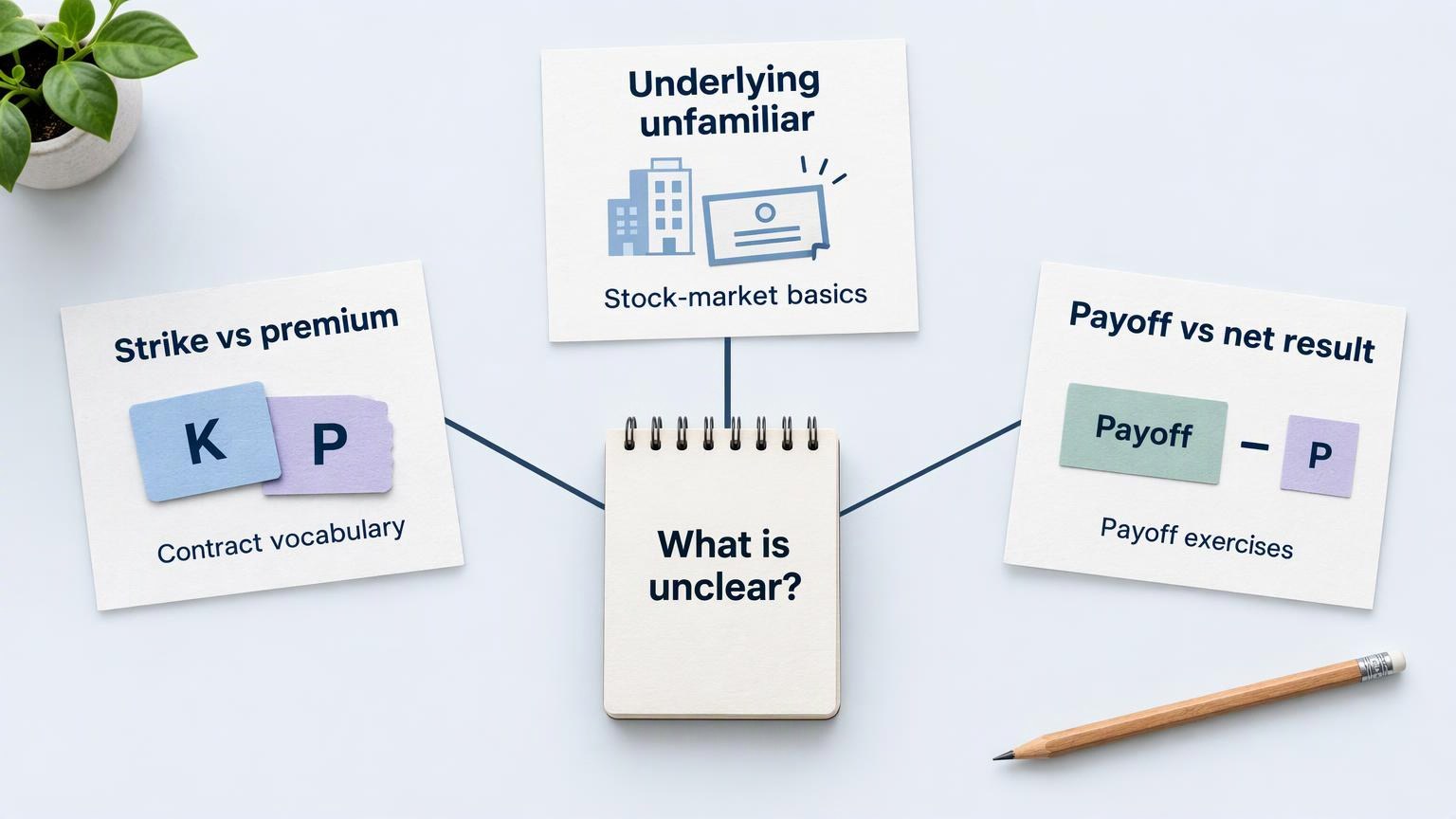
Illustration of a branching study diagram linking “What is unclear?” to stock-market basics, contract vocabulary and payoff exercises on separate paper cards.
How does this primer connect to learning in Andheri?
Our Basic Futures & Options course is the relevant next reading for this subject. Its FAQ says the course usually covers calls and puts, how pricing works, and profit-and-loss diagrams.
That connection matters because a definition alone does not show whether you can apply it. Understanding what a call is should lead to reading its terms, separating premium from strike, and explaining the difference between exercise value and the buyer’s result.
For Andheri enquiries, our office is at Pearl Plaza, Room 121, Andheri West, Mumbai. Call +91 9769870994 or use our course enquiry contact page to confirm prerequisites and current Andheri learning options before planning a visit.
Be clear about your starting point: whether you already understand stock-market basics, which contract fields confuse you, and whether you can follow the expiry example. Confirm current course coverage, batch availability, and delivery format with our team; a course page is not a reservation for a particular session.